





Why hierarchy?
A hierarchical structure shows a clear relationship between people within an organization. A relationship in which the authority of employees is derived from their place within the hierarchy. The more authority, the higher the place in the organization and the more limited the number of positions with that authority. Therefore, a hierarchy often has an inverted pyramid shape. The main advantage of a hierarchy is the clarity it provides.
However, existing hierarchies are changing very rapidly. The so-called top down control of organizations, where what should be done is imposed from the top down, is giving way to more bottom up. And there are valid reasons for this.
Why is hierarchy disappearing within organizations?
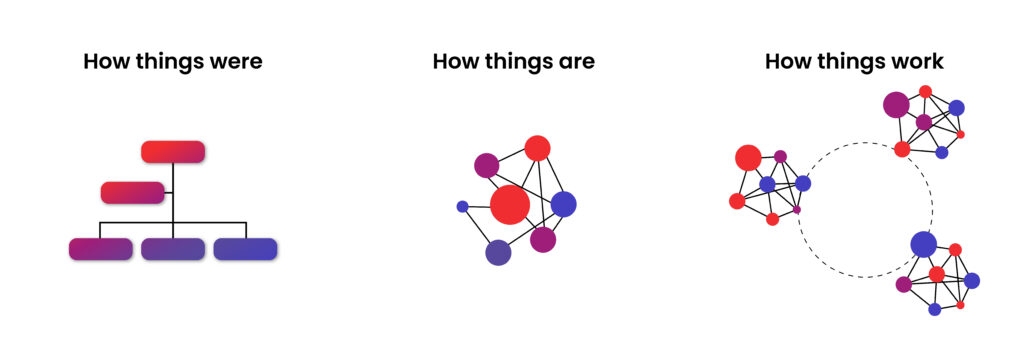
More and more organizations are organizing themselves differently. In the first picture above "how things were" you see a hierarchical organization. A few years ago, organizations were still operating in this top-down management mode. In the second picture 'how things are' you see the change that many organizations are going through at the moment. The hierarchy as we were used to is disappearing more and more and organizations are working more and more in teams. There is still structure in the form of managers who manage the teams. In the third picture "how things work," you can see where many organizations are going in the future. The hierarchy disappears almost completely and employees work in a network of teams. In this, one team works on a common project with a common goal. In this way of working together, the team is central and there is much less hierarchical leadership. In this way of working, responsibility lies with the team and mutual continuous feedback is enormously important. By working this way, the organization becomes much flatter, more agile and there is much more room for innovations.
How do you move from hierarchy to self-directed teams?
In a self-directed team , leadership is distributed. All members of the team are equal and share the work together and that means there is little/no hierarchical leader. That does not mean there is no hierarchy. There is certainly leadership in a self-directed team, but in a different way. Everyone is the leader over his/her specialty.
It may come across as if this way of working is more casual. Nothing could be further from the truth, however. The control that a manager traditionally had has now been replaced by self-control and by control of the team.
The team works from a common mission; a common goal. Everyone contributes from his or her strengths. It is therefore important that you have insight into this yourself and that others can also find you on your strengths. In addition, during team meetings on a very frequent basis, the state of affairs is reviewed. Where are we and are we still on track? If your contribution is not as agreed or expected, adjustments will be made quickly.
It will come as no surprise that insight into competencies, working with 360 feedback and working with goals form an important basis. The Treams platform brings all these things together. Add to that the optional role of a coach in the platform and you have the tools to make self-management fly.