




We live in a rapidly changing world. The way we set up our workplaces and organizations is changing profoundly. Agile organization is also the order of the day. This also involves other HR tools. At Treams, we see that more and more organizations are doing away with annual appraisals and implementing a new, agile process in which the needs and performance of employees can be anticipated more quickly. After all, if you move quickly as an organization in a dynamic environment, it also means that the growth and performance of employees must match this. What we ultimately want to achieve are performing employees who can continuously develop and learn, in a dynamic environment. But what is actually wrong with the traditional way of assessing? And what then is the difference with agile performance management?
What is wrong with the traditional way of assessment?
The traditional way consists of one or two interviews a year where there is a review and a score is given based on a five-point scale about the employee's performance. However, 59% of employees are dissatisfied with this method of appraisal and even 90% of HR leaders say the process hardly provides accurate information. Employees have little to no ownership and goals are imposed by managers or organization. In addition, appraisals often say more about the appraiser than about the person being appraised. Finally, conducting appraisals takes a lot of time and therefore a lot of money. On average, a manager spends 200 hours a year (!) having these conversations, and for a process that does not lead to satisfaction at all, it is something that should be scrapped quickly.
The difference between traditional performance management and agile performance management
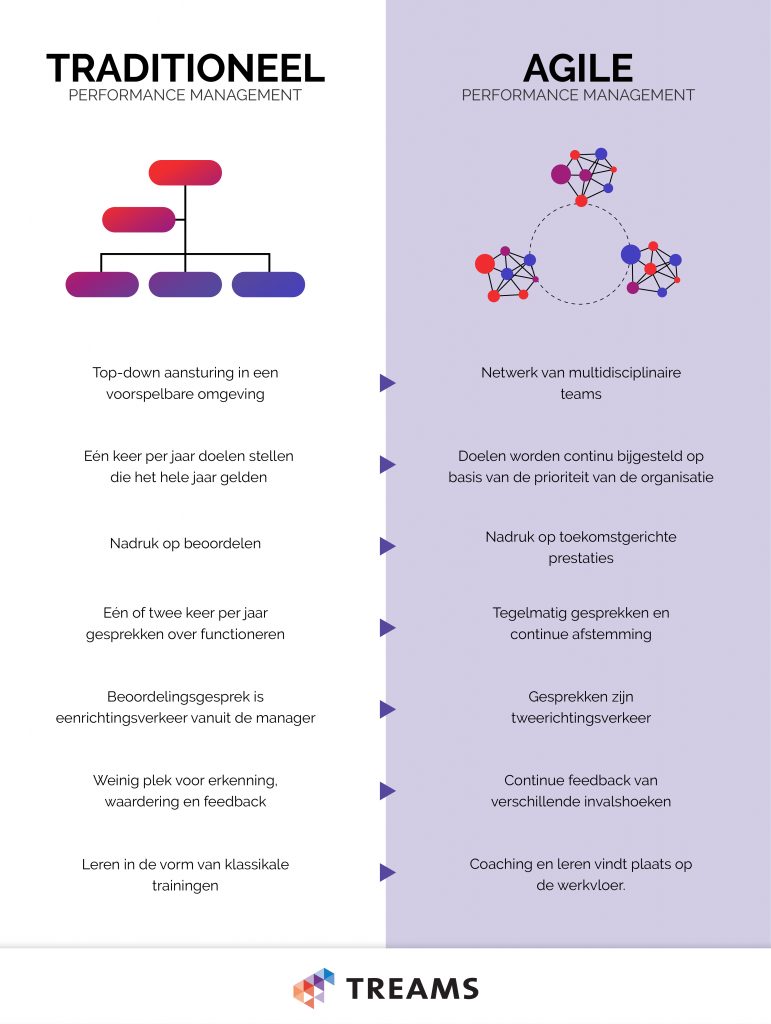
The difference between traditional performance management and agile performance management has primarily to do with how organizations classify themselves. The traditional performance management cycle is designed for a hierarchical environment. This involves top-down management and also assumes a predictable environment. Goals are often set once a year that apply throughout the year. The emphasis in this traditional process is on review. So looking back and passing judgment on the past period. There are often conversations about performance and assessment once or twice a year, and the assessment conversation is a one-way conversation from the manager. There is also little room for recognition and appreciation and little feedback is given. Finally, learning in this classical way of performance management is seen in the form of training that takes place in classrooms. Again, it is often only determined once a year who will attend which training courses and whether there is sufficient budget for this.
Agile performance management aligns with agile organizations. An agile organization consists of a network of teams organized around a goal, a project or a customer. A team is often multidisciplinary and therefore does not have to consist of people from one department. This way of working is designed for optimal collaboration. The emphasis here is on development and forward-looking performance. Looking forward rather than looking back. In this cycle, there are regular conversations and continuous coordination about what needs to be done and how to do it. Goals are not set at the beginning of the year, but can change in response to organizational or environmental priorities. There is continuous feedback and coaching and learning takes place on the job rather than at a training institute.