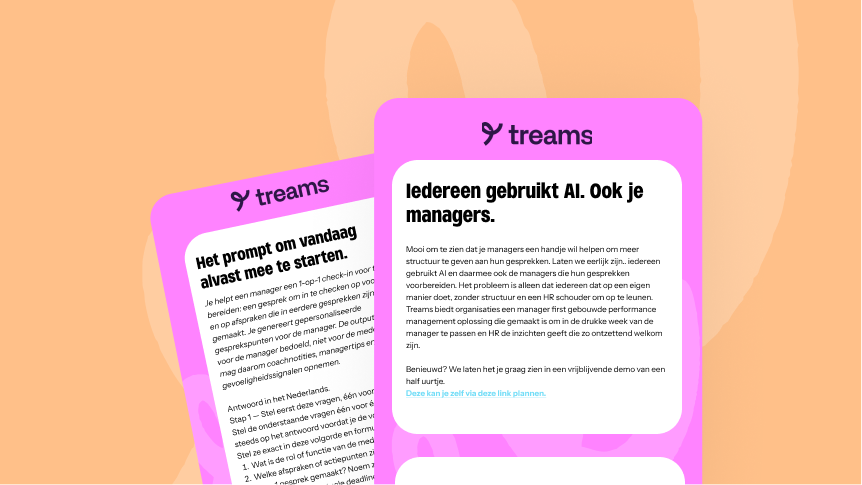
AI prompt for preparing a 1-on-1 conversation
A ready-to-use AI prompt for preparing a 1-on-1, built around the talking points you decide on.

- Your managers already prepare their conversations with AI. Everyone does it differently, and nobody knows how.
- A prompt without a framework produces prep that sounds right and is about no one in particular.
- The download contains one prompt for preparing a 1-on-1, ready to copy.
- Plus the five blocks it is built from, so you can rewrite it to match the way you work.
- Works in ChatGPT, Claude, Copilot and Gemini.
- And the honest limit: what a standalone prompt cannot do, and what you need instead.
The prompt your managers use for their 1-on-1s. Now with HR in it.
You will not hear about it, because nobody mentions it. But the manager with a 1-on-1 at half nine and five minutes to prepare pastes his notes into ChatGPT and asks: what should I talk about?
That is not lazy. That is exactly what you would do with five minutes.
Except there are thirty of those managers in your organisation. Thirty homemade prompts, thirty ways of shaping a conversation, and not one that anyone in HR has ever seen. The policy you spent six months on is in none of them.
A prompt without a framework gives you prep with no floor
Ask an AI tool for 1-on-1 questions and you get questions. Decent ones, even. How are you doing? What are you stuck on? What do you need from me?
They fit every single person on the team. That is the problem.
The tool does not know what was agreed in March. Not which goal was adjusted, not what feedback came in two weeks ago, not that this is the third time the same subject has come up. Whatever it does not know, it fills in with what is true on average.
It sounds like a good conversation. It is a conversation about nobody.
What is in the prompt
The prompt is built from five blocks. The download spells each one out, and says why it is there.
1. The role and the frame
Who the AI is, who it works for, and what a 1-on-1 means in your organisation. Without this, the tool falls back on an American coaching style that does not match how you work.
2. What the manager brings
Four things the manager pastes in: what was agreed last time, the goals in play, recent feedback, and what he has noticed himself. This is the part most managers skip, and the part that makes the difference.
3. The talking points
The subjects that belong in every conversation at your organisation. This is where you replace our examples with yours, and where your policy gets into the prompt.
4. The shape of the output
One page of prep: an opening question, three subjects with the reason each one is there, and the question the manager would rather avoid. Not an essay nobody reads.
5. The limits
What the AI does not do. No judgement about the employee, no evaluation text, no conclusions the manager should be drawing himself. The manager holds the conversation, the tool prepares it.
How to make it yours
Replace the talking points with your own. Decide whether you share it in Dutch or in English. And put it where your managers already look: the intranet, the onboarding pack, or the email announcing the next round.
Where a prompt runs out
At context. The prompt is only as good as what the manager pastes into it. Which means looking up the agreements, the goals and the feedback, and typing them out again, every time. He will do that the first time. By the fourth he pastes in his own notes only, and you are back to the decent questions that fit everybody.
In Treams the talking points are already there, set up by HR. Treams AI uses them alongside what is already on file: earlier conversations, goals, feedback. The manager opens the conversation and the prep is waiting. Nothing to look up, nothing to retype.
And what the AI does not do here, it does not do there either. No judgement, no evaluation text. The human stays in charge.
Want to see what that looks like? Half an hour is enough. Book a demo